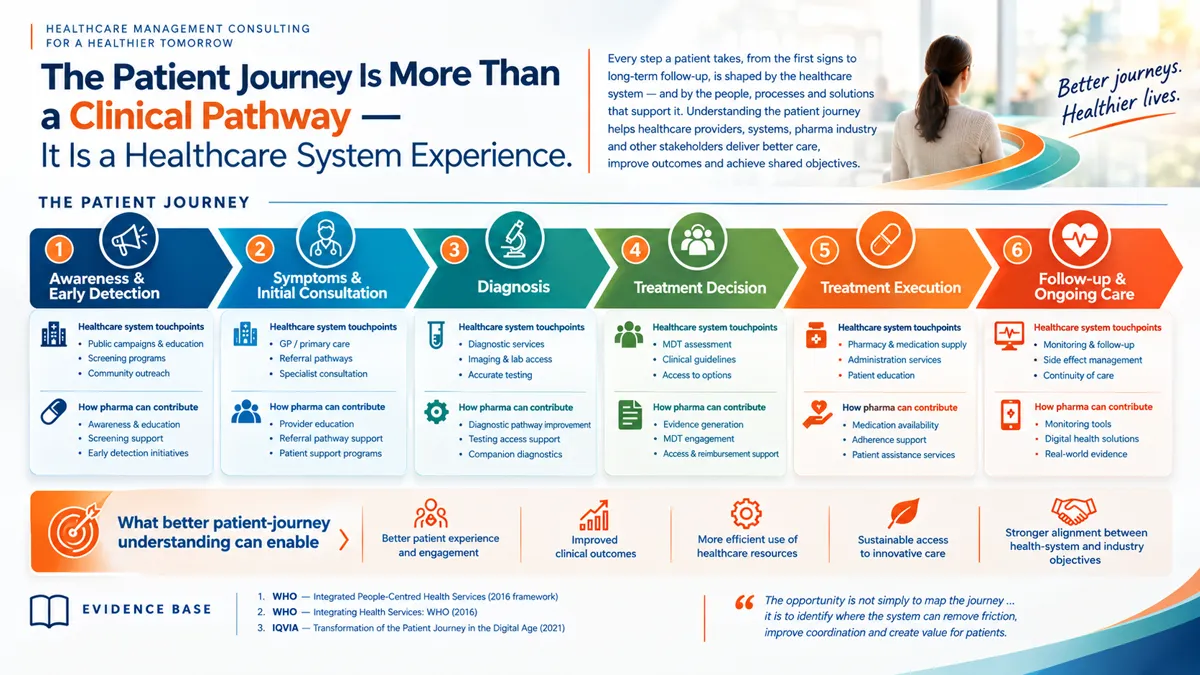
Ask most healthcare teams to describe a patient journey and they will sketch a straight line: symptom, diagnosis, treatment, follow-up. That line is real, but it isn’t the journey. The experience a patient actually lives is shaped by every decision, access point, referral, administrative step, and person they encounter along the way. That fuller picture is what the World Health Organization means when it calls for integrated, people-centered health services: care that is coordinated across the continuum, built around patient participation, and judged on accessibility, quality, efficiency and continuity, not on clinical outcome alone.
What a Patient Journey Actually Includes
A clinical pathway is a protocol. A patient journey is what happens when that protocol meets a real health system: its waiting rooms, referral letters, insurance approvals, pharmacy stock, and the follow-up calls that do or don’t happen. From first awareness through diagnosis, treatment, and long-term follow-up, every one of those moments shapes how a patient experiences care, and whether they stay engaged with it. Treat the clinical pathway as the whole story, and the rest of that experience gets managed by default, not by design.
Where the Journey Actually Breaks
Access, diagnosis, referral, treatment availability, administration and follow-up all carry equal weight in how a journey plays out, and each is a place where things can quietly go wrong. In the health systems we work across in Egypt and the wider MENA region, that’s rarely a diagnosis problem, it’s a coordination problem: journey mapping exists to make those breakpoints visible, the friction, duplication, delays and coordination gaps a symptom-to-treatment diagram was never designed to show.
- Every touchpoint can influence outcomes. A single weak handoff, a delayed referral, an unclear discharge instruction, a follow-up call that never happens, can undo weeks of otherwise sound clinical care.
- Friction hides in the handoffs. Mapping is most useful exactly where responsibility changes hands: between departments, between providers, between one stage of care and the next.
From Mapping to Measurable Improvement
A map is only useful if it changes something afterward. Interventions should respond to the specific needs the mapping surfaces, not run as isolated activities layered onto a system that hasn’t actually changed, and that starts with keeping the patient’s own voice at the center of the exercise. WHO’s recent work on patient-experience measurement treats accessibility, continuity, coordination and people-centeredness as measurable dimensions of primary-care performance, not soft, unmeasurable ideals. A journey map that never produces a number worth tracking hasn’t finished its job.
The Takeaway
The goal isn’t a better diagram of the clinical pathway, it’s a healthcare journey that is more coordinated, more accessible, more responsive, and sustainable enough to hold up under real patient volume, not just the version drawn on a whiteboard. Getting there starts with mapping the journey patients actually live, not the one the org chart assumes they do.
Back to Insights